
From Pour to Cure: Recording Every Batch

Hey soapmaking friends! Let’s talk record keeping.
I giggled a bit writing this section in my book and again while working on this blog. All my life, I thought I was a type-A, ultra-organized personality. One year, when I was teaching about personality types, I proudly told my students I was type A. My teacher’s aide laughed out loud and said, “Just look at our desks!” We all looked over—hers was perfectly organized, and mine… was a creative mess.
That’s when I realized: I like to think I’m organized, but in reality, it’s something I have to focus on and deliberately practice. And it’s very important in soapmaking! Take it from me—don’t spend your time scribbling notes on scraps of paper and Post-its! I realized by my third batch that organization was the secret to real growth. I’m not naturally a "Type A" person. I’ve had to truly focus on organization in a meaningful way, and I promise—cross my heart—that keeping accurate records will alleviate a lot of stress and greatly speed up your learning.
To help you do just that, I’m sharing a Soap Batch Record Form, available as both a printable PDF and a Google Sheets version, so you can choose what works best for your workflow.
Why Accurate Record-Keeping Matters
Accurate records help you refine your craft, stay consistent, and build a strong foundation—especially if you’re testing natural colorants or additives. This is even more vital when working in micro-batches for experimentation, where small changes make a big difference.
A Built-in Memory Aid: Let’s be honest, it’s easy to forget what you did in a batch weeks or months ago. Writing things down helps you remember ingredient amounts, methods, and those little tweaks so you can repeat them with confidence.
Perfect Your Formulations: When you track each batch, you can make thoughtful adjustments and fine-tune your soap until it’s just right.
Recreate Your Favorites: When you create a bar you absolutely love, records make it easy to duplicate. No more guessing how much essential oil you used or which oils gave it that perfect feel. Ask me how I know... you really won’t remember without a record!
Stress-Free Troubleshooting: If a batch doesn’t turn out as hoped, your notes help identify what went wrong. Looking back to see what changed makes troubleshooting far less frustrating.
Transparency & Safety: Even if you only make soap for family or friends, I recommend keeping an ingredient list. Even natural ingredients can cause sensitivities. Clear labeling protects those we care about and helps us all learn more about what we love on our skin.

Keeping records supports personal growth as a soap maker. Looking back at older batches shows just how far you’ve come—and helps you see where you may still want to improve.
Natural Colorant Testing
Colorants: Note what you used, how much, and how you added it.
Infusions: Record the ratios (e.g., did you infuse 4 tablespoons of powder in 2 or 3 cups of oil?).
Ratios in Soap: Document how much of your infusion or water replacement went into the soap (e.g., 10% annatto-infused oil + 100% carrot juice).
Environmental Factors: Things like insulation, gel phase, or CPOP can all affect the final color.

Want to Skip the Trial and Error?
The world of natural colorants is vast, and experimenting can take months—or even years—of your time. If you want a "rainbow roadmap" of organic soap colors, grab a copy of From Seed to Soap.
Inside, you’ll find step-by-step guidance and charts for over 25 natural colorants, showing you the exact amounts to use and how to incorporate them. Create beautiful, vibrant, natural soaps with total confidence from batch one!
Record Keeping: Save Yourself the Headache (and the Heartbreak!)
You can jot things down in a spiral notebook while making soap, but I highly recommend transferring your notes into an organized system when you have a chance. That’s actually how my book came to life—I realized all my organized notes could save others a lot of time!
Record keeping might sound tedious, but trust me—it pays off. Whether you’re curating your own custom formulas or experimenting with natural colors, keeping notes will save you a world of frustration. If you’re doing the hard work of experimenting, you want to be able to recreate those "perfect" results again and again.
I highly recommend keeping your soap formulas separate from your color and additive experiments. This allows you to perfect your foundation while staying organized during your creative "mad scientist" phase!
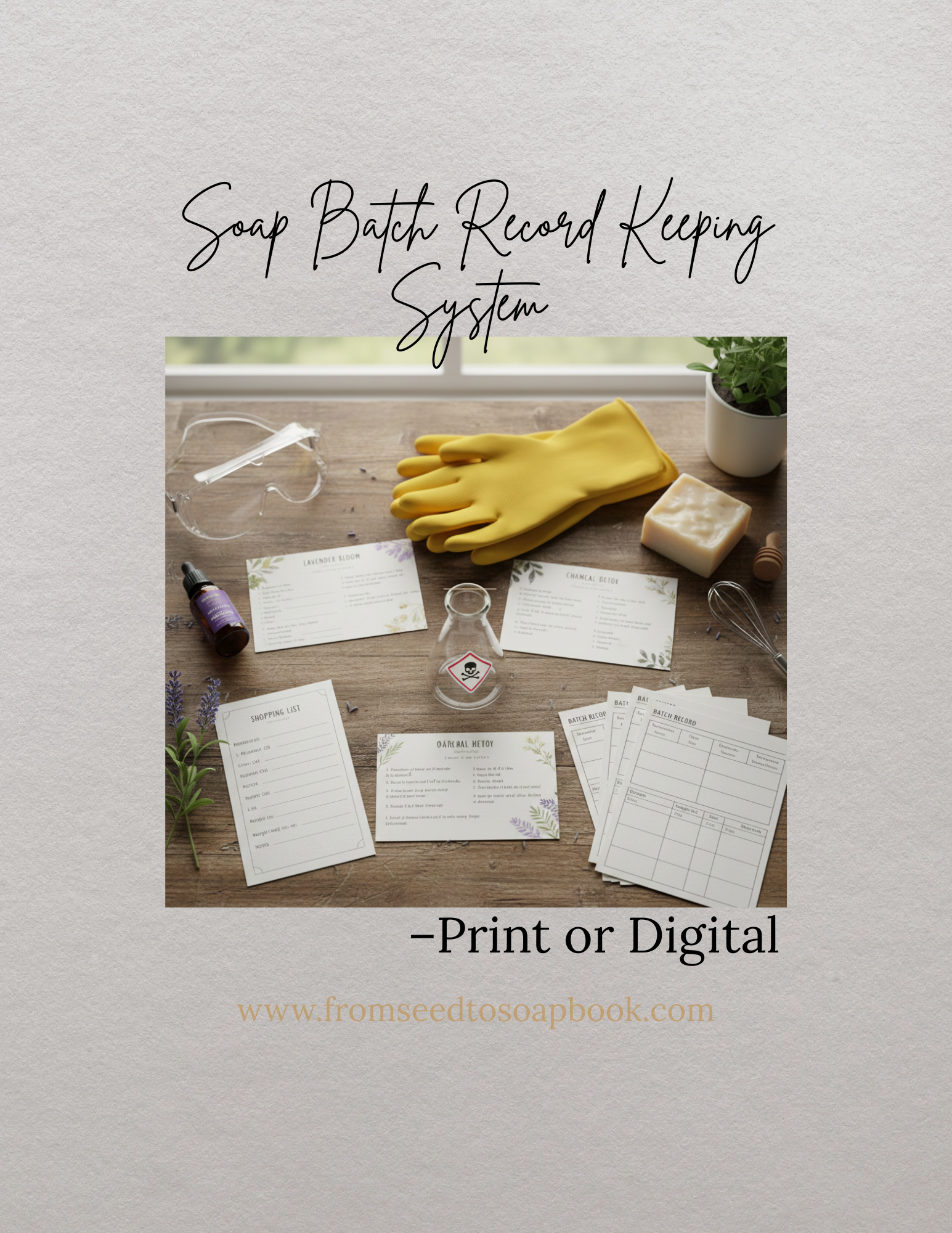
Don’t want scattered notes?
I’m sharing my personal batch record system to help you skip the "scrap paper phase" and get straight to the good stuff. As a busy mom and wife, I personally prefer digital records. I’m exactly the type of person who will lose a paper note, only to find it tucked into a random book three years later!
To save you from my early mistakes, my free download includes two ways to stay organized, both versions allow you to track soap formulations as well as color expiramentation.
The Google Sheets Version: This is my personal favorite. It stays tucked safely in the cloud so you can’t lose it—ideal for those of us who prefer typing over hunting for a pen.
The 9-Page Printable PDF: Perfect for makers who love a physical binder, a clipboard, and the feel of a pen on paper.
That’s actually how my book, From Seed to Soap, came to life! I realized that my years of organized notes, failed experiments, and "aha!" moments could save other makers years of tedious research.
I’ve put together a color experimentations form, and it’s included in my FREE soap batch recording download—perfect for keeping track of your natural color tests!
Want a free beginners soapmaking kit? It includes the soap batch recording downloads, free recipes and lye safety information. Just join the newsletter!
Disclaimer: This guide is for educational purposes only. These statements have not been evaluated by the FDA and are not intended to diagnose, treat, cure, or prevent any disease. Always consult a healthcare professional for medical concerns and perform a patch test before trying new products.
Affiliate Disclosure: This post may contain affiliate links. As an Amazon Associate, I earn from qualifying purchases at no additional cost to you. I only recommend products I truly trust and use in my own home.
